In its simplest form I think of journalism as ‘the gathering and sharing of factual information with other people.’ That process has been going on for thousands of years — both orally and in written form. Ancient governments often informed citizens about official proceedings and daily events through written publications like the Acta diurna in Rome and the bao in China.
‘Scribes’ are an example of people specially trained in reading and writing. Much of what we know about ancient history is because of what scribes recorded, copied, and archived. Another example of people trained in writing is the ‘amanuensis.’ Though they were often literate slaves in antiquity, amanuensis were eventually employed to write what people said. That included taking dictation and making transcriptions. Some of the earliest forms of mass communications and journalism were hand written documents.
The invention of the printing press in the 15th century AD slowly changed the physical process of mass communication from written manuscripts to printed materials. However, that was not what made journalism a ‘profession.’ That would come many years later.
Freedom of the Press
The ‘free press’ written about in the First Amendment of the U.S. Constitution was not what I would term a ‘profession.’ The term ‘press’ used in the First Amendment came from the way people understood printing technology. Anyone with access to a printing press could share information with other people. That information might be true, but it could also be false. Much of early ‘journalism’ in America was partisan and sensational. There were no ‘standards’ of journalistic conduct. People wrote stories based on political or business interests. They were not trained and followed no code of conduct.
The process of the ‘press’ going from being partisan and sensational to becoming professional was slow. The ‘penny press’ made newspapers available to more working-class Americans. The growth of interest in newspapers meant the potential for publishers to make more money. Two of the leaders of publishing growth in the 19th century were Joseph Pulitzer and William Randolph Hearst. Their fierce competition to attract readers led to what became known as ‘yellow journalism’ — sensational and exaggerated headlines with claims that were often not verified.
Development of Ethical Standards
Interestingly, Pulitzer funded the Columbia School of Journalism that opened in 1912. The University of Missouri founded the first school of journalism in 1908. Both schools played important roles in developing journalism as a profession. The schools emphasized the importance of accuracy and objectivity as part of being a professional journalist.
Newspapers also worked to improve the ‘profession.’ The American Society of Newspaper Editors (ASNE) was founded in 1922 and changed its name to The American Society of News Editors in 2009.
The American Society of News Editors focuses on leadership development and journalism-related issues. Founded in 1922 as a nonprofit professional organization, ASNE promotes fair, principled journalism, defends and protects First Amendment rights, and fights for freedom of information and open government. Leadership, innovation, diversity and inclusion in coverage and the journalism work force, youth journalism and the sharing of ideas are also key ASNE initiatives. About ASNE
The emphasis on ethical standards within journalism schools, newspapers, and radio news in the early 20th century played an important role in the development of the standards I and other journalism students learned and practiced years later. Those standards included:
A formal education in journalism and/or mass communications
Codes of journalistic conduct
Fact-based reporting
Impartial reporting
Editorial independence
Another organization that promoted ethical standards for journalists in the early days of the 20th century was ‘The Society of Professional Journalists’ —
The Society of Professional Journalists is the nation’s most broad-based journalism organization, dedicated to encouraging the free practice of journalism and stimulating high standards of ethical behavior. Founded in 1909 as Sigma Delta Chi, SPJ promotes the free flow of information vital to a well-informed citizenry through the daily work of its thousands of members; works to inspire and educate current and future journalists through professional development; and protects First Amendment guarantees of freedom of speech and press through its advocacy efforts. About SPJ
I was a member of SPJ for many years and appreciated the emphasis on high standards for journalists. Other groups I joined through the years that helped promote journalistic standards are:
Given this brief history of the development of journalism as a profession with ethical standards, why has trust in the press (news media) plummeted in recent years? What happened? Even journalists recognize that something has changed —
Maintaining high ethical standards is essential to the practice of journalism, particularly in a climate of eroding public trust in the American press and the pervasive spread of misinformation. SPJ Ethics
It is the alarm of our moment, and one gets the sense that the pitch of anti-press sentiment is now the most fevered it’s been since the founding of the republic. Columbia Journalism Review
As I wrote several months ago —
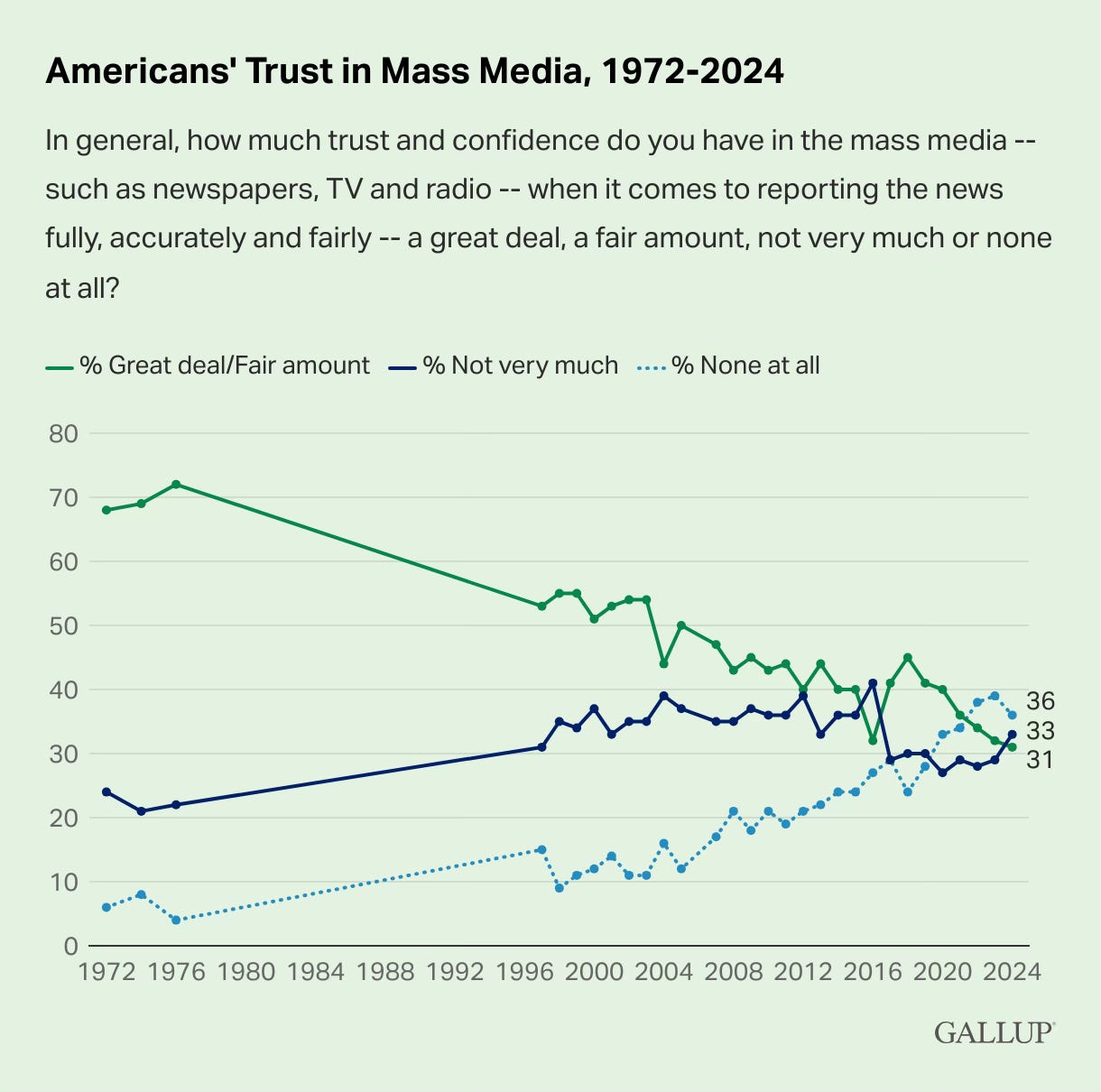
It’s been my observation and concern for decades that journalism (especially national journalism) in the United States was losing its focus on the importance of building ‘trust’ with news consumers. There was a time when audiences believed what they saw on a television newscast, heard on a radio newscast, or read in a newspaper. Unfortunately, too many journalists and their managers no longer care as much about finding, confirming, and reporting truth as they are about pushing personal or corporate narratives. Trust In News Media Lowest In 50 Years (Gallup)
Time for Change?
Rather than admit any personal or professional responsibility concerning the loss of public trust, many members of the ‘mass media’ today believe it’s time for change in ‘ethic standards’ of journalism that have stood for more than a century. Here are some examples from a Columbia Journalism Review article titled, “Is Objectivity Still Worth Pursuing?A generation of journalists is challenging traditional standards.”
“The consensus among younger journalists is that we got it all wrong,” Emilio Garcia-Ruiz, editor in chief of the San Francisco Chronicle, told former Washington Post executive editor Leonard Downie Jr. They believe: “objectivity has got to go.”
In some cases, that has led to newsrooms leaning into their reporters’ personal perspectives, as when reporter Kevin Rector of the LA Times wrote about the legal threats to gay marriage via the lens of his same-sex marriage.
“There is definitely a generational tension going on right now in newsrooms between traditional notions of things like objectivity and younger journalists who are more comfortable with advocacy than their older mentors and editors and news directors may be,” said Kathleen Culver, director of the UW-Madison School of Journalism and Mass Communication.
“Journalism is not objective, and we all know this,” said University of Missouri associate journalism professor Jared Schroeder. “All objectivity is setting up a set of processes and practices to do your best to be objective. It’s a system; it’s not a goal; it’s not an automatic outcome. Journalism is supposed to be providing information to audiences that is accurate and useful for democracy. Well, if that’s the end goal, then your systems and your processes, your practices, should align with reaching that goal, which I think that approach would leave room for different ways of getting there, because the objectivity that is taught in journalism schools generally, historically and traditionally is a one-way system.”
A potential middle ground between advocacy journalism and traditional objectivity is solutions journalism, a reporting style that has gained in popularity in recent decades, spurred in part by the 2013 founding of the Solutions Journalism Network. The gist of solutions journalism is to examine how society is responding to a social problem and review the evidence to see whether the response is effective by talking with industry experts and the public. The media industry has largely been critical of solutions journalism, saying it risks straying into advocacy or focuses too much on upbeat stories.
Other newsrooms have opened their policies on journalists’ participation in protests. In 2020, Axios sent a memo to staff saying, “We proudly support and encourage you to exercise your rights to free speech, press, and protest.” Columbia Journalism Review
President Trump: The Reason for Changing Ethical Standards?
Even though the downward slide of American’s trust began in the mid-1970s (see the Gallup chart above), decades before Donald Trump first announced his presidential candidacy, many journalists today believe Trump is the primary reason to make changes to ethical standards in journalism.
In some areas, we heard calls for change. “Traditional journalistic norms and conventions for covering politics and politicians were not created for a president like Donald Trump,” said Rod Hicks, executive editor of the St. Louis American and formerly the director of ethics and diversity at the Society of Professional Journalists. Stephen J. Adler, director of the Ethics and Journalism Initiative at the NYU Arthur L. Carter Journalism Institute and chair of the steering committee of the Reporters Committee for Freedom of the Press, argued that “the media isn’t doing its job in correctly balancing the news value of a leak versus. the news value of who made the leak and why.”
One of the legacies of Donald Trump’s presidency is that politicians have learned they can manipulate the press—more so than before—with few, if any, repercussions. Traditional journalistic norms and conventions for covering politics and politicians were not created for a president like Donald Trump. CJR
Trump’s brazen dishonesty in his public comments is without political precedent in this country. During his first term, the Washington Post’s fact-checking database clocked 30,573 untruths. That rate shows no sign of slowing during his second term, and now he seems to be combating accusations of lying by simply manipulating who is allowed in the press pool.
“Our norms and conventions of how we cover politics and politicians were not created for a president like Donald Trump,” Rod Hicks, director of ethics and diversity at the Society of Professional Journalists, says.
Hicks questions the utility of “both sides” journalist protocol in covering politicians who’ve taken cues from Trump on manipulating the press to their advantage. “Every side doesn’t deserve equal weight,” he said. “It’s actually misleading your audience if you give too much weight to something that evidence says is not valid. We think that we’re doing our jobs by following this both-sides rule, but we really aren’t.”
Newsrooms have struggled to find a way to hold Trump accountable. Initially, media outlets were hesitant to use the word lie, preferring falsehood so as to ward off accusations of bias or personal attack. To lie denotes an intention to deceive.
“I don’t know that we’ve called him a liar in so many words,” said Tony Cavin, the managing editor for standards and practices at NPR. Cavin prefers descriptions over labels, he said.
Seth Lewis, a journalism professor at the University of Oregon, believes that journalists shouldn’t be wary of calling out lies and racism. Otherwise, he says, they unwittingly become mouthpieces for untruthful speech. CJR
Time for a Reset?
Is it time for a ‘reset’ in the profession of journalism? If journalists want to rebuild the trust they’ve lost with the American public, I think the answer is obviously YES! However as a journalist and news manager with more than 60 years experience in a variety of mass media, I believe the answer is not ‘making changes’ to ethical standards of journalism but ‘returning’ to the standards that made journalism a profession which built trust among a diverse population in the United States.
I also think it is fool-hardy for journalists to blame any politician, whether President Trump, or former presidents Biden, Obama, Bush, or Clinton for the audience’s low opinion of the ‘press.’ The first president I covered was Lyndon Johnson, followed by Richard Nixon, Gerald Ford, Jimmy Carter, Ronald Reagan, and George H.W. Bush.
The reason I wrote a recent article titled, ‘Lying: It’s What They Do,’ is because I spent decades covering people in powerful positions. I caught them in lies and exposed their lies through reporting that was backed up by confirmed facts. That kind of journalism does not make you popular with people in power, but it does accomplish the work of being a journalist committed to ethical standards: Accuracy & Objectivity.
Each person who won the presidency during the past century brought a variety of challenges to journalists, but why change long-held ethical standards because of any one leader and their administration? Are journalists suggesting that they should change their ethical standards for covering an American president and his or her administration depending on who wins an election? I would certainly hope not, but the American public has seen that very thing happen with their own eyes — thus the rapid decline in trust. Journalists are seen protecting some people in power while attacking others. The audience is not blind or deaf. They see what they see and know what they know. So, where do we go from here?
Rebuilding Trust
The question is whether journalists really want to rebuild the trust they once enjoyed. I don’t believe many of them are interested in rebuilding trust. They are activists and that’s what drives them to do journalism the way they do. However, for those who care about returning journalism to proven ‘professional standards’ they have a lot of hard work ahead of them to make that happen. It won’t be easy and it won’t be quick. Losing trust took years of falling away from the ethical standards established by thousands of journalists who came before them. Regaining public trust will most likely take many years, possibly even decades, but don’t let that keep you from coming home to Real Journalism. It’s worth the trip to come home.
One of the first steps is for journalists to take a long, honest look at themselves and their profession. They need to compare their work to the ethical standards that made journalism a profession that Americans used to trust. If the comparison falls short, journalists need to shift their priorities to do whatever is necessary to turn the ship around and head in the right direction.
Coming Up
During the next several months I’m going to share some of the lessons about ‘ethical standards’ I learned during a lengthy career in journalism. I hope you will join me for this important journey and share the newsletter series with your friends in journalism.
Comments and Questions Welcome
I hope these thoughts are helpful to you. Please share your comments and questions and I will respond as quickly as I can. If you like what we’re doing in this newsletter, please let your friends know about it so they can subscribe.
Newsletter Purpose
The purpose of this newsletter is to help people who work in the fields of journalism, media, and communications find ways to do their jobs that are personally fulfilling and helpful to others. I also want to help news consumers know how to find news sources they can trust.
[The Real Journalism Newsletter is published every other Tuesday morning — unless there’s ‘breaking news!]
Mark McGee’s Newsletter is a reader-supported publication. To receive new posts and support my work, consider becoming a free or paid subscriber.